 Schedule of Classes
 Maps
 Canvas
 Directory
 Library
 LancerPoint
 Calendars
 Bookstore
 Student Email
 News & Events
 Police & Safety
 PCC Connect
 Parking
 COVID-19 Info
Board Bylaws, Policies & Administrative Procedures
Pasadena City College's Board Bylaws, Board Policies, and Administrative Procedures establish the framework for District governance, decision-making, and operations. Together, they provide direction for the District, define responsibilities, and support compliance with applicable federal and state laws and regulations.
View PCC's Bylaws, Policies & Procedures on Diligent Community
Understanding BBs, BPs, and APs
Review and Approval Process
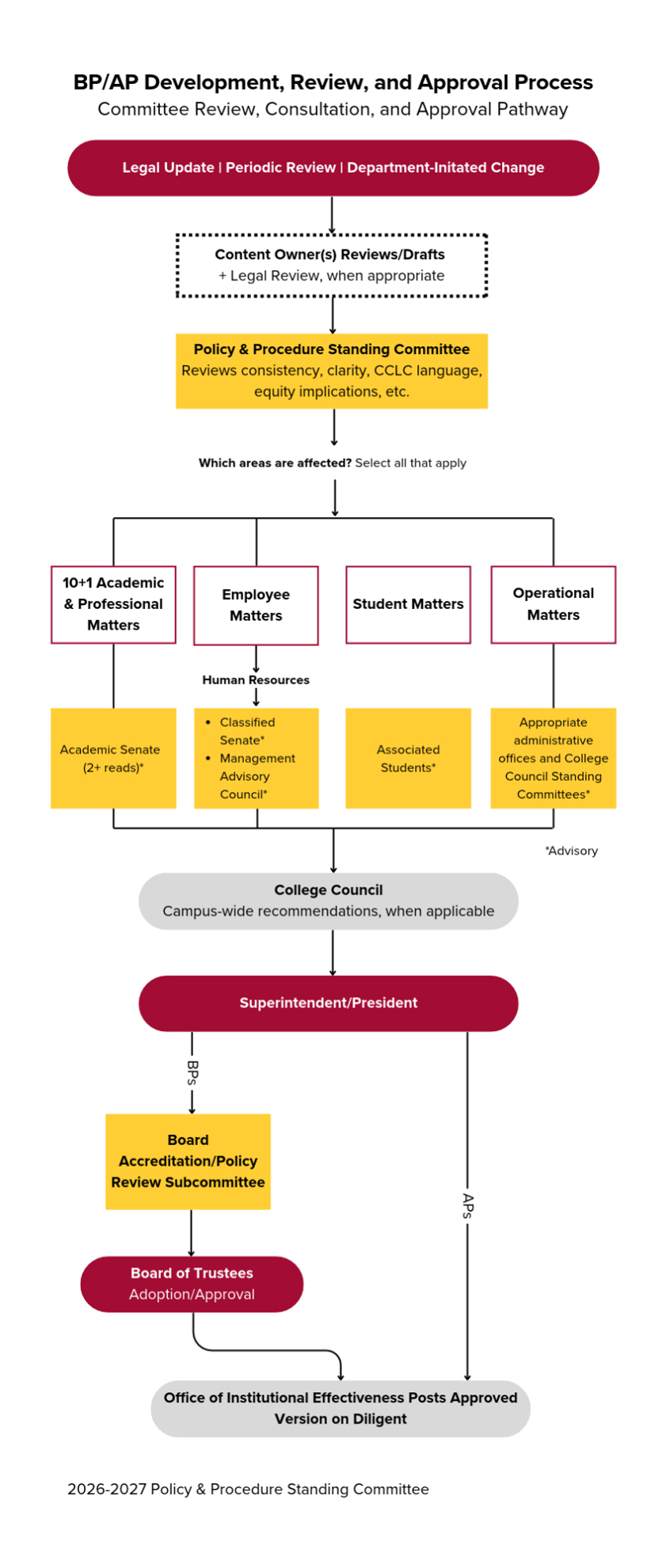
In accordance with BB 2410 Board Policies and Administrative Procedures, the District regularly reviews and updates its Board Bylaws, Policies, and Administrative Procedures to ensure legal compliance and alignment with institutional practices. The review and approval process outlined below applies to revisions of BPs and APs in Chapters 3-7.
Substantive Revisions
Substantive revisions are changes that affect the meaning, requirements, responsibilities, or implementation of a Board Bylaw, Board Policy, or Administrative Procedure. These revisions may result from legal updates, periodic reviews, or department-initiated changes.
Proposed revisions are drafted by the responsible content owners and reviewed by the Policy and Procedure Standing Committee. Revisions are then routed to appropriate constituency groups and committees for consultation, followed by College Council review, when applicable.
Final recommendations are forwarded to the Superintendent/President. Board Policies proceed to the Board Accreditation/Policy Review Subcommittee and Board of Trustees for approval, while Administrative Procedures are approved by the Superintendent/President. Once approved, the Office of Institutional Effectiveness publishes the updated documents in Diligent.
Technical/Nonsubstantive Revisions
Minor changes that do not alter the meaning or requirements of a bylaw, policy, or procedure, such as corrections to grammar, formatting, titles, hyperlinks, or legal citations, are reviewed, recommended, and made by the College Council Policy and Procedure Standing Committee without undergoing the full review and approval process.